



Not all chews are created equal. A bully stick that’s perfect for a 30 kg Labrador could be a choking risk for a 5 kg Maltese. And a chew that keeps an aggressive chewer occupied for an hour might splinter dangerously in the mouth of a more powerful breed.
Choosing the right long-lasting chew comes down to four things: your dog’s size, their chewing style, the chew’s hardness, and how closely you can supervise. Get those four right and chew time becomes one of the safest, most enriching parts of your dog’s day.
The single most important rule: always supervise your dog with any chew, and remove it when it becomes small enough to swallow whole.
Why Long-Lasting Chews Matter
Long-lasting chews offer real benefits beyond keeping a dog occupied. Regular chewing supports jaw muscle development, helps reduce plaque and tartar build-up through mechanical abrasion, and provides mental stimulation that can ease anxiety and boredom-driven behaviours. For high-energy dogs, a good chew session can be as tiring as a 20-minute walk.
The key is matching the chew to the dog, not the other way around.
Step 1: Match the Chew to Your Dog’s Size
Size is the first filter. A chew that’s too small for a large dog becomes a swallowing hazard immediately. A chew that’s too large for a small dog can cause jaw fatigue or put excessive pressure on teeth.
Use this as a starting guide:
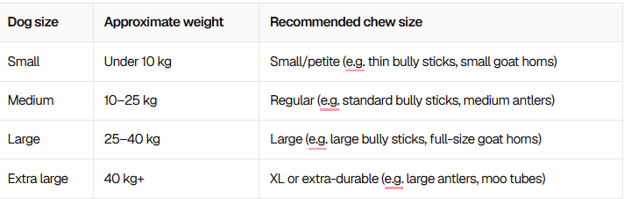
When in doubt, go one size up rather than down. A chew that takes longer to work through is safer than one a dog can break apart quickly.
Step 2: Know Your Dog’s Chewing Style
Chewing style is just as important as size. Dogs generally fall into three categories, and the wrong chew for their style is where most accidents happen.
Light Chewers
Light chewers nibble and lick rather than crunch. They tend to be smaller breeds, older dogs, or dogs with dental sensitivities. Soft, pliable chews work best: thin jerky strips, collagen chews, or softer bully sticks. Hard chews like antlers are not appropriate for light chewers as they can cause tooth fractures.
Medium Chewers
Most dogs fall here. Medium chewers work through a chew steadily without trying to demolish it in one sitting. They handle the widest range of dog treats safely: bully sticks, goat horns, collagen sticks, and tendons all suit this profile. Long-lasting dog chews for medium chewing styles are a good starting point for this group.
Hard (Power) Chewers
Power chewers are the dogs that destroy a standard bully stick in under ten minutes. They need durable, dense chews: whole deer antlers, large goat horns, and thick moo tubes. The risk with power chewers is not the chew itself but the speed at which they consume it. Supervision is non-negotiable, and any chew should be removed once it reaches a size that could be swallowed.
Step 3: Understand Chew Hardness
Hardness is the most misunderstood variable. Many owners assume harder equals safer, because the chew lasts longer. That logic is backwards. Chews that are too hard for a dog’s teeth are one of the leading causes of slab fractures, where a large piece of tooth shears off. These fractures are painful, often require veterinary treatment, and are entirely preventable.
A useful rule of thumb: if you press your thumbnail into the chew and it leaves no mark at all, the chew may be too hard for most dogs. This applies particularly to:
- Cooked or smoked bones — cooking makes bone brittle and prone to splintering
- Very dense antler pieces — split antlers are safer than whole for most dogs
- Nylon or synthetic chews — these are not digestible and can cause intestinal blockages
Natural, single-ingredient chews like bully sticks, tendons, goat horns, and collagen sticks offer a better balance: durable enough to last, but with enough give that they reduce fracture risk.
A note on raw bones: raw bones from a butcher can be appropriate for some dogs, but they carry bacterial contamination risks and should always be given fresh and supervised. Speak to your vet before introducing raw bones, particularly for immunocompromised dogs or puppies.
Chew Safety Checklist
Run through this before introducing any new chew to your dog:
- The chew is appropriately sized for your dog’s weight and breed
- You have identified your dog as a light, medium, or hard chewer
- The chew passes the thumbnail test (has some give under pressure)
- The chew is a single-ingredient, natural product with no artificial additives
- You are present and can supervise for the full chew session
- You know the removal point: when the chew is small enough to swallow in one piece, take it away
- You are introducing this chew for the first time in a calm, low-distraction environment
- If your dog has a history of gulping food or has had gastrointestinal issues, you have checked with your vet first
First-time tip: Introduce a new chew type for 15–20 minutes only on the first session. Watch for signs of excessive gulping, gagging, or digestive upset over the following 24 hours before making it a regular treat.
When to Remove a Chew
Knowing when to take a chew away is as important as choosing the right one. Remove the chew immediately if:
- It has been chewed down to a piece smaller than your dog’s mouth opening
- You notice sharp edges or splinters forming
- Your dog starts gulping rather than chewing
- Your dog shows signs of distress: pawing at the mouth, excessive drooling, or gagging
- You need to leave the room and cannot maintain supervision
Some owners use a chew holder or bully stick grip to make removal easier and prevent their dog from swallowing the last nub. These are particularly useful for fast, enthusiastic chewers.
Storing unfinished chews: natural chews can be refrigerated between sessions to keep them fresh. Most single-ingredient chews will keep for several days in an airtight container in the fridge.
Finding the Right Chew for Your Dog
Once you know your dog’s size and chewing style, the selection process becomes straightforward. Natural, single-ingredient chews made in Australia are the safest starting point: you know exactly what is in them, there are no artificial preservatives or additives to worry about, and the sourcing is transparent.
For dogs that need something that lasts, WAG’s long-lasting dog treats cover the full range of chewing profiles, from softer collagen sticks suited to light chewers through to whole deer antlers and large goat horns for power chewers. All are single-ingredient and Australian-made.
If your dog is a confirmed hard chewer, the hard chewer dog treats range is worth exploring specifically: it is curated for durability rather than just treat type, which takes the guesswork out of the selection.
The right chew, given safely and at the right time, is one of the simplest ways to support your dog’s dental health, mental wellbeing, and overall happiness. Start with size and chewing style, use the checklist above, and supervise every session until you know how your dog handles a new chew.